
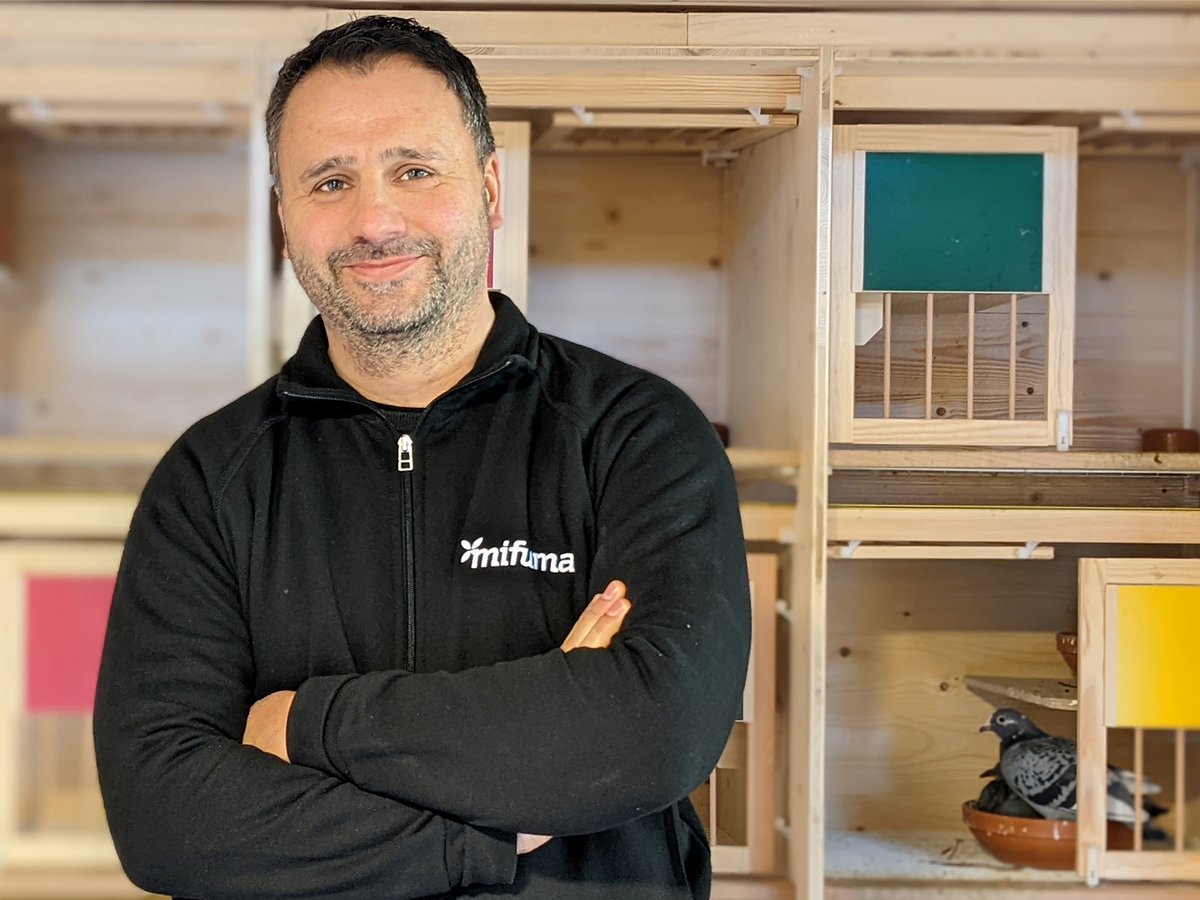
Our new product manager for pigeon feed, Robert Maaß, is among the top breeders in Germany. The sports enthusiast tells us how he prepares his pigeons for the journey and what thoughts he has before starting the new season to end up on the podium.
Our new Product Manager for pigeon feed, Robert Maaß, is among the top pigeon breeders in Germany. In this interview, the fancier explains how he prepares his pigeons for racing and what considerations he makes before the start of a new season in order to stand on the winners’ podium at the end.
Tip 1: Free Flying and First Training Sessions
The winter rest period is over and a new pigeon racing season begins. Now it is time to get my racing pigeons back into shape and condition. During winter, I was only able to let my pigeons out for free flying sporadically. On the one hand, the weather rarely cooperated and on the other hand, birds of prey visited quite frequently. As a result, the pigeons spent most of their time in the loft and aviary. During this time, however, they gained a little too much fat.
I therefore switched my feed to a lighter diet mixture from Mifuma. Mifuma Fitness is particularly suitable for this purpose. This all round mixture with barley and paddy rice is very high quality thanks to components such as Top Mais and the Vollkraft Perle. However, to ensure that the pigeons still have enough energy available for their daily training, I additionally mixed in 50 percent of my racing feed, Elite Racing. Elite Racing already contains the Aktiv Perle, which promotes condition and eagerness to fly thanks to added L Carnitine.
With this feeding concept, I was able to get the pigeons training very well and they quickly built up good stamina. During the first free flights, however, I proceeded very carefully. They were allowed to fly their rounds without pressure and stay in the air as long as they wanted. This helped prevent wing injuries. If pigeons are overworked right at the beginning, it can quickly lead to unbalanced flying. Of course, I want to avoid that at all costs.
I gradually increased the training so that they are now training for one hour a day. My pigeons are already in excellent condition. This can also be seen in their shiny and silky smooth plumage. The breast muscle is pinkish red and free of scales. That is exactly how it should be!
Tip 2: Loft Management and Feeding
At the beginning of April, I pair my pigeons for a second time. During this period, I also begin road training. For me, this has the advantage that I can basket all pigeons from one loft together and I do not have to separate them again after the training flight. Here, I rely on my many years of experience.
If the weather is suitable, I now take my pigeons out for training flights every day. I gradually increase the distances from 10 km up to 60 km, which also steadily increases the flight duration.
My feeding still consists of Mifuma Fitness and my racing mixture Elite Racing. However, I continue reducing the proportion of Fitness. Since I race my pigeons using the dry widowhood system, they are separated again after six days of incubation. If everything goes according to plan, this happens directly after the first training race.
On the evening of race day, I remove the racing hens from the loft and place them in the hens’ section. The cocks are allowed to continue incubating their clutch until they leave the nest by themselves. Only then do I remove the nest bowls from the loft.
From the first prize race onwards, my racing pigeons receive only Elite Racing. Hens and cocks are fed equally. I race my pigeons total widowhood style, meaning that both cocks and hens are entered into races.
Tip 3: Caring for Young Pigeons
From the time they are weaned, my young pigeons receive Zucht und Mauser Sonderklasse. The breeding pigeons have already fed their youngsters with this high quality mixture. It contains everything I value in nutrition during the rearing period, such as high fat components like hemp, maize, and sunflower seeds, as well as a basic supply of vitamins and minerals from the Vollkraft Perle.
I want to avoid changing the feed for the young pigeons. In this mixture, they find everything they need for healthy development. Even after weaning, young pigeons continue developing. Soon the moult of the smaller feathers begins. At this stage, pigeons require sufficient protein so that the feathers can develop properly. They receive this in a high quality and easily digestible form through the Power Erbsen.
Once all pigeons have been weaned, they are vaccinated against young pigeon sickness using the RP vaccine. Three weeks later, they receive the second vaccination.
The first round of my young pigeons is already flying freely. They are diligently making their first laps around the house and have already started exploring the nearby surroundings. During the day, they receive two hours of free flying during which they can do whatever they like. They should develop without stress. I also enjoy seeing them walking around on the lawn in front of the pigeon loft. Later on, they are only rarely allowed to do this.
Gradually, I begin preparing these young hopefuls for their future tasks. I regularly place them into a transport basket and let them out in front of the loft after one hour. In this way, they become familiar with the basket and learn that when the flaps are opened, they are allowed to come out. Drinking through the bars is also important and should be learned early. Inside the loft, I use a “HerWi Tränke”. This teaches them to drink through bars, just as they will later experience in the transport truck.
From the end of March until June 21, the day of the summer solstice, I darken my young pigeons. This is intended to prevent them from moulting their flight feathers. That way, they still have a full wing during the races and are more competitive. They are darkened from 5:00 p.m. in the afternoon until 6:00 a.m. the following morning. From June 22 onwards, they are then exposed to light from 6:00 a.m. until 10:00 p.m. This is when the pigeons truly come into form and can shine in the young bird races.
Tip 4: Selection of Racing Pigeons
All pigeons that are physically healthy are given a chance as young pigeons in my loft. However, if a pigeon becomes sick and is unable to recover on its own, I remove it from the loft. For me, selection based on health is the most important criterion in pigeon racing.
According to my experience, health is the foundation for success in pigeon racing. If the entire loft becomes ill, then of course I treat my pigeons with medication as well. However, this is always done according to the veterinarian’s treatment plan. I do not believe in blind treatments. If pigeons are healthy, they do not need medication. Much more important are a well functioning loft system and the supply of high quality pigeon feed and supplements.
Tip 5: My Personal Advice
In spring and during the shorter distance races, the goal is to build up the pigeons’ condition. However, when the races become longer, it does no harm to allow the pigeons some rest. Especially with greater distances, the races demand a considerable amount of energy from the pigeons.
Therefore, it is often better to keep the loft closed one or even two days before basketing and give the pigeons enough time to recover. They will reward you with top results and early prizes.
I wish all fellow fanciers a successful start to the new racing season.