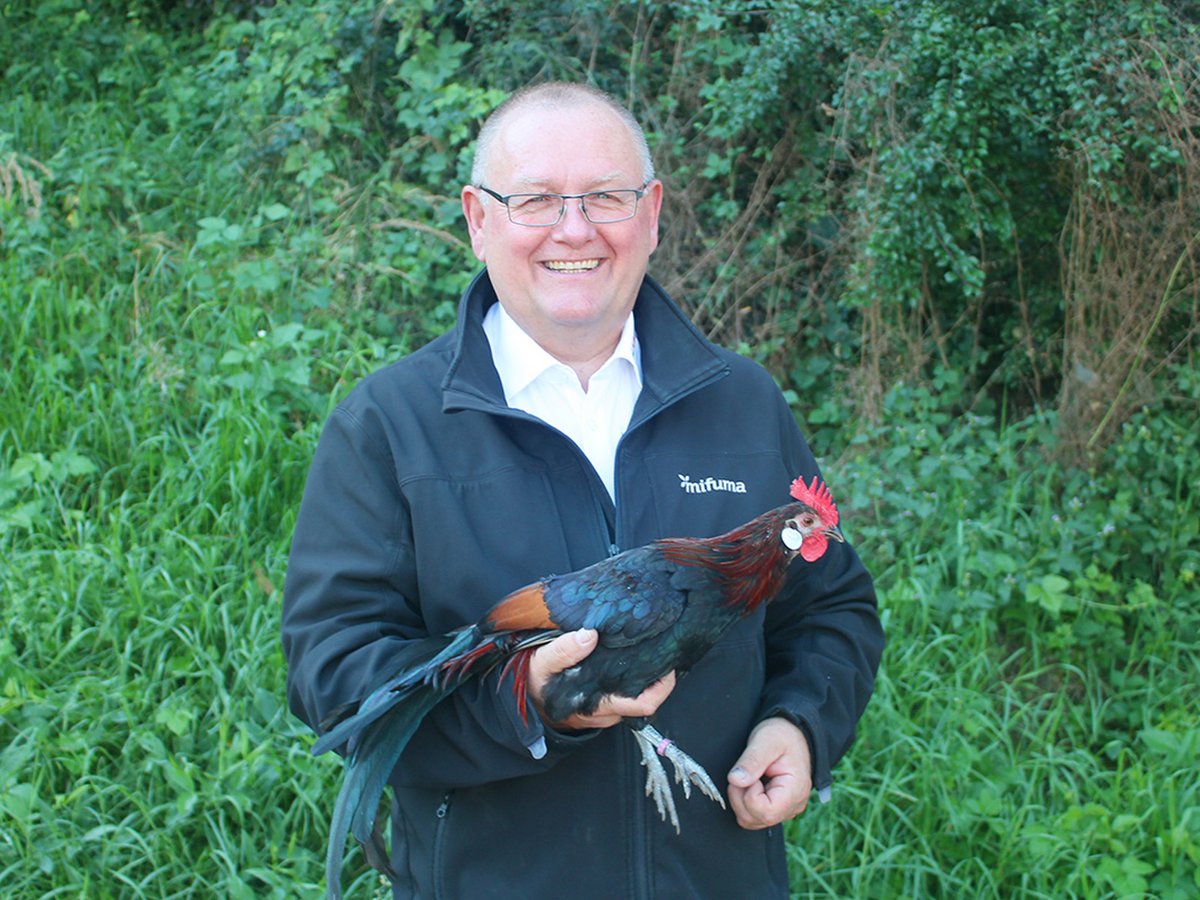
Our poultry expert Georg Welker is not only responsible for developing our poultry feed range, but has also been a passionate breeder of various poultry breeds for more than 30 years, including Mechelner and Brabanter Bauernhühner, as well as quail and runner ducks. Below, he shares his advice on how to successfully breed purebred poultry and what to consider when selecting the right feed.
The exhibition season is over, and breeders have selected the animals or breeding groups they want to use moving forward. When determining the ratio of hens to rooster, experience with the respective breed is essential. With bantams, this can be up to 1,10 (1 rooster and 10 hens), with heavy breeds around 1,3, and with game breeds sometimes only 1,1. The breeding animals are brought together, and it is important to observe whether they harmonize and whether the rooster fulfills his role.
Especially when a young rooster is introduced to older hens, challenges may arise. Some hens may show dominant behavior and refuse mating. In such cases, it can be helpful to house the hen separately and allow the rooster access, for example in the early morning hours. In newly formed groups, hens will initially establish a hierarchy, which usually settles after a few days.
Special attention should now be given to feeding and feed selection. Before exhibitions, animals may have been fed a rich and energy dense diet to improve body condition or feather appearance. This can lead to excess fat in selected breeding animals.
It is now important to bring the animals into proper breeding condition. Overweight or overly fat hens may show reduced laying performance. Similarly, heavy or fat roosters may not perform effectively. As the saying goes, a good rooster is rarely fat.
These animals need to be conditioned. Feeding a protein rich diet has proven effective, for example Mifuma Legemehl or Pellet Premium combined with Fischprotein Plus. Protein rich dairy products such as curd cheese, yogurt, or sour milk are also sometimes used to stimulate laying activity. Once laying begins, feeding should be switched to a breeder feed or hatching egg feed, such as Mifuma Zucht Premium Mehl or Pellet, or Frucht- und Gemüsekorn Premium. These feeds contain higher levels of vitamins and additional components such as essential fatty acids, which support fertility and hatchability. These feeds are designed as complete feeds and should not be diluted with grain.
What distinguishes a breeder feed from a standard complete feed can be illustrated with Vitamin A. For basic reproduction, 6,000 IU is sufficient, whereas a high quality breeder feed contains around 18,000 IU. Another example is linoleic acid. Without it, hatchability is 0 percent. With an inclusion of 20 mg, hatchability can reach up to 89 percent.
These feeds should be provided about four to six weeks before collecting hatching eggs, allowing the animals’ metabolism to adapt. The health status of the breeding animals is also crucial. Only healthy and vital animals should be used for breeding.
Housing conditions must also be considered. During winter, breeding animals should not be exposed to freezing temperatures. Even if sunny weather is tempting, cold ground winds can negatively affect fertility. At this time, indoor housing is recommended.
It is also important to collect hatching eggs promptly during cold weather to prevent chilling or freezing. Eggs should be stored at 8 to 12 degrees Celsius, with the blunt end facing upward or placed sideways, and turned daily. A dry coop and clean nesting areas are essential for collecting quality eggs. Light dirt can be carefully removed under running water using a soft brush. Heavily soiled eggs should not be used, as cleaning may damage the protective layer or block pores. Such eggs may also indicate feeding issues or bacterial contamination.
Collected hatching eggs should be stored for a maximum of 10 to 12 days. The incubator should be tested in advance and thoroughly cleaned and disinfected.
With these preparations, nothing stands in the way of a successful breeding season.
Wishing you every success in breeding.
Georg Welker
Mifuma Product Manager Poultry
If you have any questions about breeding, feel free to contact us at info@mifuma.de.