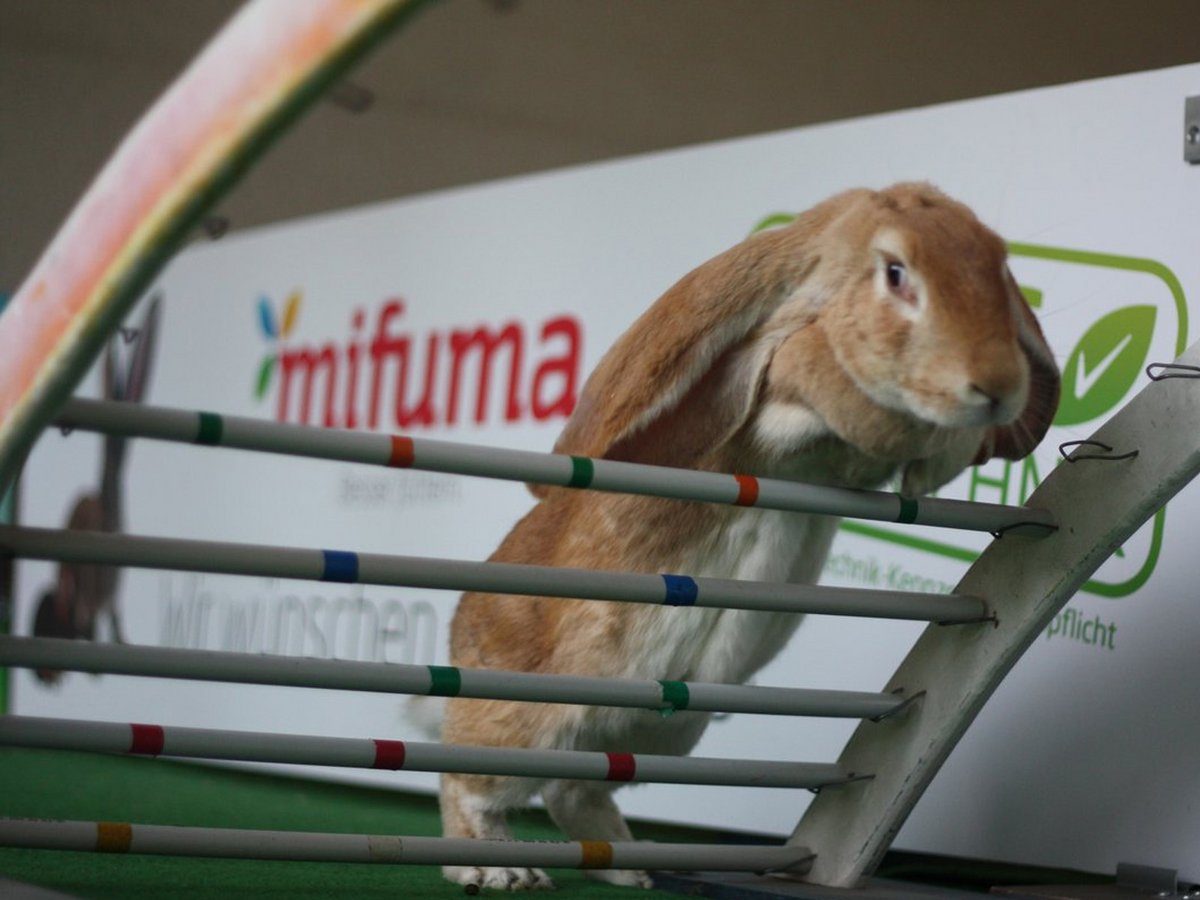
Rabbit hopping, known as Kanin-Hop, is a shared sport for both humans and animals. In this activity, tame and trained rabbits jump over obstacles arranged in a jumping lane or obstacle course. Depending on the competition class, the rabbits either jump freely or are guided by their owner on a leash attached to a harness. The sport encourages activity and interaction between humans and animals while strengthening their bond. Rabbits are highly intelligent and naturally active animals, and Kanin-Hop provides an excellent outlet for their need for movement.
The History of Kanin-Hop
The origins of Kanin-Hop date back around 50 years to Sweden. Initially, Swedish pedigree rabbit breeders simply encouraged their rabbits to jump over obstacles to keep them occupied and provide sufficient exercise. Via Denmark, Kanin-Hop arrived in Germany in 1995 through the breeding club U31 Eutin e.V.
Since then, numerous Kanin-Hop groups have been established, most of which are organised through pedigree rabbit clubs affiliated with the Zentralverband Deutscher Rassekaninchenzüchter (ZDRK). Training sessions are supervised by specially appointed Kanin-Hop representatives who monitor not only the sporting requirements but also the housing conditions and health status of the rabbits.
Animal welfare and protection are the highest priorities, both in the handling and training of the rabbits and in the rules governing competitions. Competitions are often held as part of shows and exhibitions, while dedicated Kanin-Hop events are also becoming increasingly popular. The best rabbits compete in regional, national, and European championships.
Kanin-Hop Rules
To participate in a Kanin-Hop competition, rabbits must be at least four months old, while handlers must be at least nine years old. Younger children compete in the guided class alongside an accompanying adult.
There is no upper age limit, and many adult breeders now enthusiastically participate in Kanin-Hop as well. Each rabbit has its own competition record book issued by the Kanin-Hop group of the respective rabbit breeding club. This book contains information about the rabbit and owner, vaccination records, and competition results. Vaccination against RHD is mandatory for participation.
The record book also tracks class qualifications and competition performances to ensure that each rabbit competes in the correct performance class according to its abilities. Breed and body size are irrelevant; only jumping ability matters.
The competition classes are divided into:
- Easy
- Medium
- Difficult
- Elite
These differ in the number, height, and width of the obstacles.
Competition Formats
In competitions, obstacles are arranged either in a straight line or as a course across a larger area. In obstacle courses, each obstacle is numbered and must be completed in a specified order, similar to show jumping in equestrian sports.
Most rabbits are guided on a leash, although there are also “open course” competitions in which rabbits complete the course freely alongside their handler.
Scoring is based on time and faults. Faults include knocking down an obstacle or requiring more than three minor or clear corrections from the handler. Similar to equestrian jumping, the poles are designed to fall easily if touched.
Competitions are judged and supervised by specially trained Kanin-Hop referees.
Healthy Nutrition for Top Athletes
Like any athlete, a Kanin-Hop rabbit requires a healthy and balanced diet. The overall ration should be adapted to the rabbit’s energy requirements to provide sufficient power while preventing excess weight gain.
Compared to maintenance requirements, the additional performance requirement is relatively moderate. Depending on the frequency and intensity of training as well as the feed used, moderate additional feed allowances of 5 to 15 g per kilogram of body weight are generally sufficient.
Depending on the rabbit breed, we recommend Mifuma Basis, Mifuma Plus, or Mifuma Struktur-Müsli. In addition to rabbit feed, Kanin-Hop rabbits should always have access to sufficient hay and fresh water.
Overview of Competition Classes and Types:
| Light |
|
| Medium |
|
| Heavy |
|
| Elite |
|
Straight Track: A series of consecutive obstacles according to the respective class
Course: Obstacles on an area with a predetermined order according to the respective class
Point Jumping: The ten obstacles are set up in a round track with a height of 25cm or 35cm. Each error-free jumped obstacle is scored with a point. The goal is to achieve the most points through error-free overcome obstacles within one minute. The rabbit that scores the most points after a maximum of 4 rounds wins.
Duel Jumping: Two parallel tracks with at least 10 identical obstacles (25cm or 35cm high) are completed by two rabbits with companions; in a knockout system, one pair is eliminated until a winning team is determined; or each team starts against each other; the rabbit with the most individual wins wins the competition
Elimination Jumping: A track with 10 obstacles, which are increased by 8cm in each of a maximum of 5 rounds; each team with less than or equal to 3 errors also starts in the next round; in the last round, errors and time decide
Source: Rules for Kanin-Hop Sport in the ZDRK, Edition 2019, Publisher: Central Association of German Pedigree Rabbit Breeders e.V.